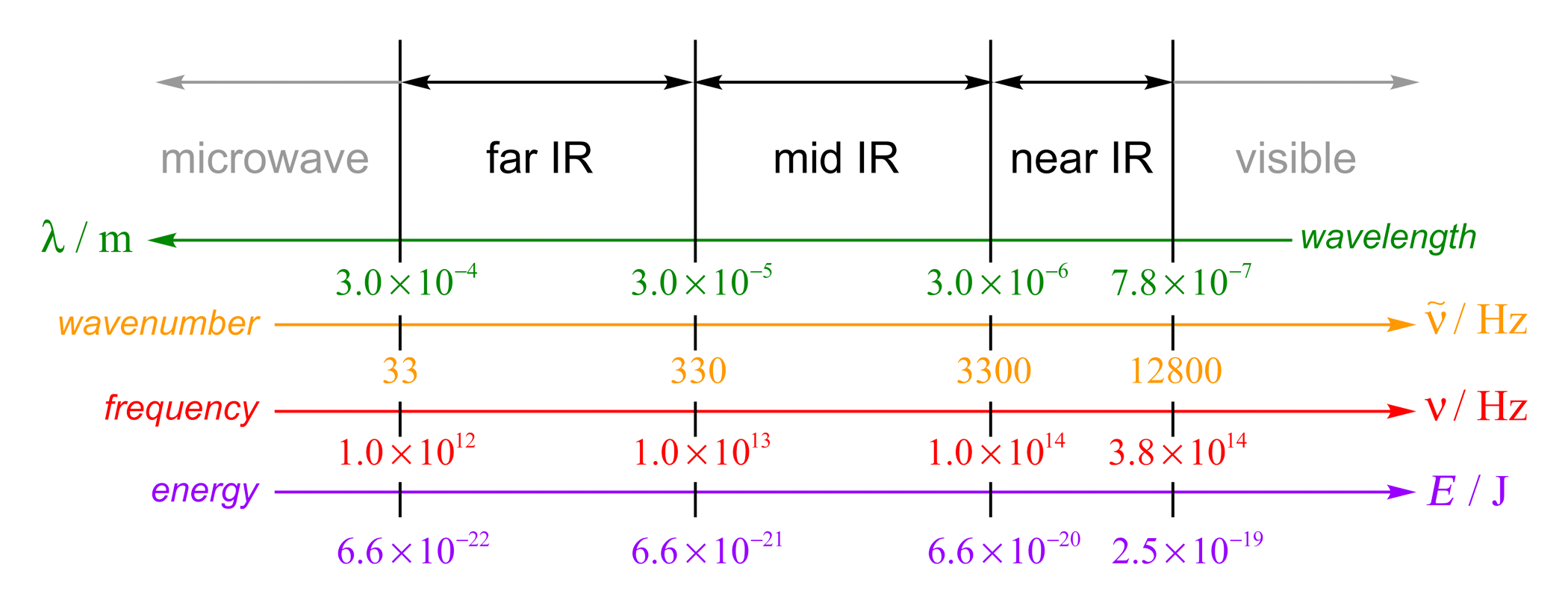
What Is The Energy Level Of Infrared Waves. infrared radiation (ir) is a type of radiant energy, with longer wavelengths than the visible light humans can see, but shorter wavelengths than radio waves. infrared waves have longer wavelengths than visible light and can pass through dense regions of gas and dust in. ir frequencies range from about 300 gigahertz (ghz) up to about 400 terahertz (thz), and wavelengths are estimated to range between 1,000. infrared radiation, that portion of the electromagnetic spectrum that extends from the long wavelength, or red, end of the. listed below are the approximate wavelength, frequency, and energy limits of the various regions of the electromagnetic. we already know that the wavelength of infrared radiation is between 700 nm to 1 mm, which is between the red limit of the visible spectrum. infrared spectroscopy reflects the type of bonding present within a molecule, learn how the energy levels of bond vibrations and dipole moments contribute to the.
from www.benjamin-mills.com
we already know that the wavelength of infrared radiation is between 700 nm to 1 mm, which is between the red limit of the visible spectrum. listed below are the approximate wavelength, frequency, and energy limits of the various regions of the electromagnetic. infrared spectroscopy reflects the type of bonding present within a molecule, learn how the energy levels of bond vibrations and dipole moments contribute to the. ir frequencies range from about 300 gigahertz (ghz) up to about 400 terahertz (thz), and wavelengths are estimated to range between 1,000. infrared radiation (ir) is a type of radiant energy, with longer wavelengths than the visible light humans can see, but shorter wavelengths than radio waves. infrared waves have longer wavelengths than visible light and can pass through dense regions of gas and dust in. infrared radiation, that portion of the electromagnetic spectrum that extends from the long wavelength, or red, end of the.
Infrared spectroscopy
What Is The Energy Level Of Infrared Waves we already know that the wavelength of infrared radiation is between 700 nm to 1 mm, which is between the red limit of the visible spectrum. ir frequencies range from about 300 gigahertz (ghz) up to about 400 terahertz (thz), and wavelengths are estimated to range between 1,000. infrared waves have longer wavelengths than visible light and can pass through dense regions of gas and dust in. infrared radiation, that portion of the electromagnetic spectrum that extends from the long wavelength, or red, end of the. infrared spectroscopy reflects the type of bonding present within a molecule, learn how the energy levels of bond vibrations and dipole moments contribute to the. listed below are the approximate wavelength, frequency, and energy limits of the various regions of the electromagnetic. we already know that the wavelength of infrared radiation is between 700 nm to 1 mm, which is between the red limit of the visible spectrum. infrared radiation (ir) is a type of radiant energy, with longer wavelengths than the visible light humans can see, but shorter wavelengths than radio waves.